Material Focus
Virgin Plastic vs Recycled: Making Plastic Equipment Last
Virgin material, UV additive, wall thickness and polymer choice decide how long a plastic drinker, feeder or bucket survives in the field. Here is what to ask a supplier.
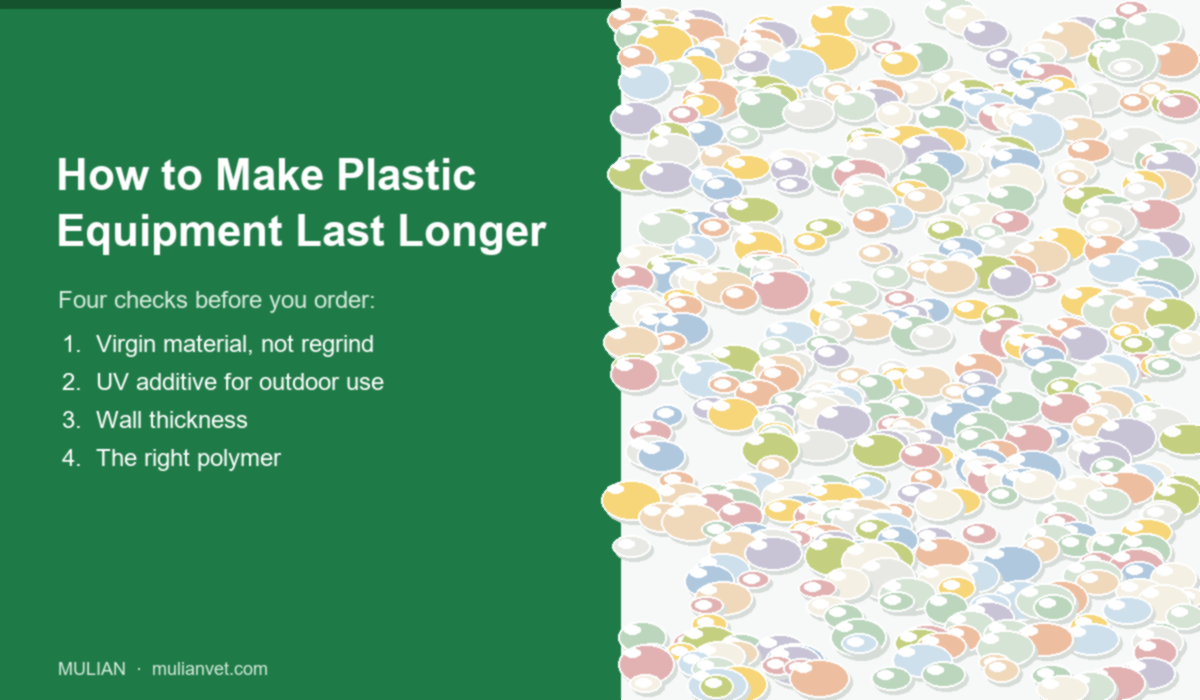
Plastic parts fail in three ways: sunlight, impact and chemical attack. Most of it traces back to four decisions made before the first moulding is shot.
The same four checks apply to drinkers, feeders, buckets, bowls and syringe bodies. None of them needs a laboratory to verify - they need the right questions.
1. Ask for virgin material, and look twice at black
Regrind - recycled production scrap, sometimes mixed with outside waste - is cheaper than virgin resin. It also carries contaminants: dust, metal fragments, other polymers. They show up as specks, dull patches or weak spots.
The catch is that these defects are easiest to see in light colours. White, yellow, light green and natural parts reveal contamination immediately; black hides it. That is why a very cheap black part deserves a closer look, and why buyers who care about consistency often specify light colours.
Ask the supplier directly: is this virgin material or regrind, and what percentage of regrind is used? A supplier who answers in numbers is usually the one worth keeping.
2. Confirm the UV additive
Sunlight breaks polymer chains. For anything used outdoors - water tanks, drinkers, troughs, buckets and feeders left in the yard - the resin needs a UV stabiliser package, usually HALS, sometimes combined with UV absorbers.
Without it the part chalks, fades, then cracks at the stress points, often within one or two seasons. With it, the colour holds and the service life extends well beyond that.
Colour alone does not tell you whether the additive is there. Ask for the UV package, not just the words "UV resistant" on a label.
3. Ask for the wall thickness
Thickness is the cheapest form of strength. A drinker with a 1.5 mm wall survives a knock that cracks a 1.0 mm one, and a thicker boss around a screw hole resists stripping.
A thicker wall also resists UV and chemical attack for longer, because there is more material to lose before the part fails.
Ask for the wall thickness in millimetres on the main body, the base and the mounting points. A supplier who quotes a range such as 1.8 to 2.2 mm is giving you a more honest answer than one who says "strong".
4. Match the polymer to the job
There is no single best plastic. Each family trades one property for another.
PP (polypropylene) - tough and chemical resistant, used for feeders, drinkers and buckets; needs a UV stabiliser for outdoor parts.
PE (polyethylene) - flexible and impact resistant, used for tubs and tanks.
PC (polycarbonate) - transparent and rigid, used for syringe barrels; some chemicals can craze it.
TPX (polymethylpentene) - transparent, chemical resistant and steam resistant, used where clarity and sterilisation matter.
PVC - cheap and rigid, used in some fittings, but less UV stable and increasingly avoided.
Choosing the wrong polymer shows up as cracking, clouding or softening in service, long after the invoice is paid.
What to put in your inquiry
Four lines cover it:
1. Material - virgin or regrind, and which polymer.
2. UV - stabilised for outdoor use, yes or no.
3. Thickness - main wall in millimetres.
4. Colour - light colours make defects visible.
Ask for a sample before a full order. If the part will live outdoors, leave the sample outside for a season before you commit to a container.
MULIAN moulds and sources plastic livestock equipment in PP, PE, PC and TPX, with UV-stabilised options for outdoor parts. Send your specification to vivian@mulianvet.com and we will reply with material, thickness and pricing.