
How To
How to Choose a Livestock Syringe: Four Questions That Decide Everything
Four practical questions — animal, dose, disposable vs reusable, tube vs bottle — that narrow a livestock syringe choice to one or two models.
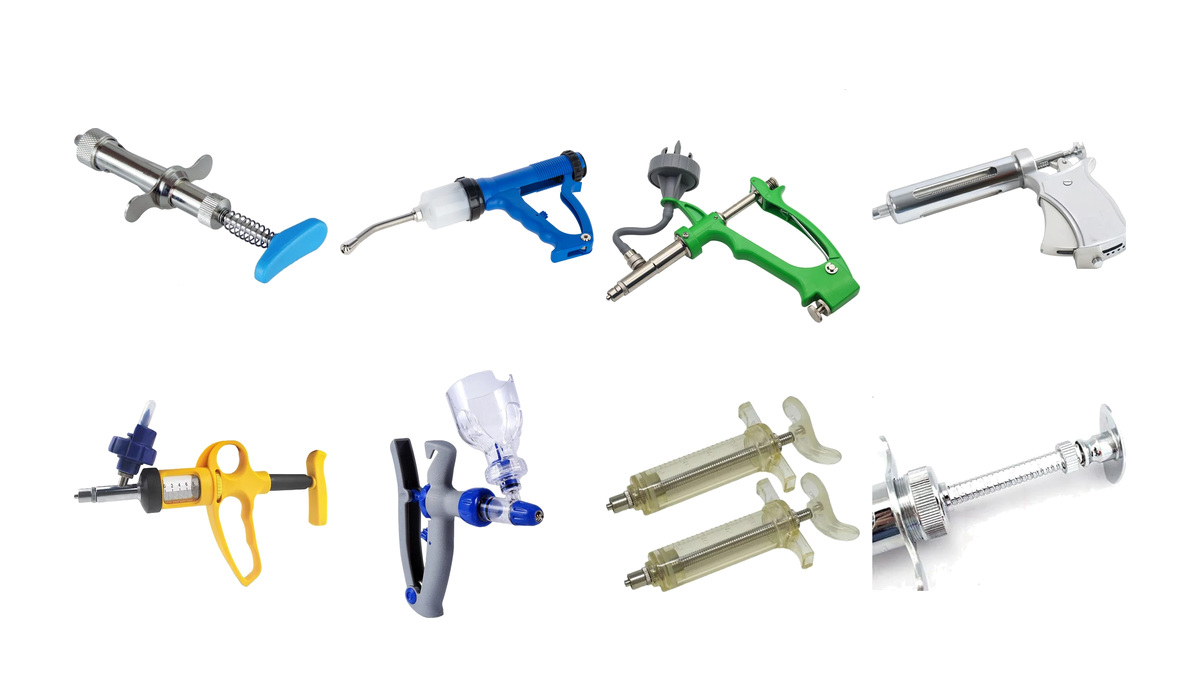
Most buyers start with price. That is usually how they end up with a tool that does not fit the job. A livestock syringe is decided by four variables, and once you answer them correctly, the suitable models narrow to one or two — price comparison becomes easy and meaningful.
1. Which animal? decides volume range and handle reach.
2. Which dose? decides barrel capacity and dose mechanism.
3. Disposable or reusable? decides running cost and disease-control risk.
4. Tube-fed or bottle-fed? decides how the vaccine reaches the barrel.
Below is how each answer maps to actual equipment.
Question 1 — Which animal are you vaccinating?
The species sets the working distance, the restraint method, and therefore the handle you need.
Poultry. Very small doses, very high throughput, birds are handled quickly. Use a compact automatic syringe in the 0–2 ml class, with a secure needle guard so needles are not lost mid-run.
Piglets and swine. Small-to-mid doses, animals move constantly. Use an automatic syringe in the 2–10 ml class; fast needle change matters more than capacity.
Sheep and goats. Mid-range doses, often handled in races. Use an automatic syringe in the 2–10 ml class with clear graduation.
Cattle. Large doses, and a 600 kg animal that can injure the operator. Use a 10–50 ml pistol-grip or metal automatic syringe, and consider a long-arm injector.
The cattle exception: operator safety
For cattle the handle is a safety device, not a comfort feature. A long-arm continuous injector — chrome-plated brass cylinder, steel alloy arm, stainless steel push rod — is specifically designed for working on large, uncooperative animals, keeping the handler outside kicking range. If your team works adult cattle regularly, this single choice prevents most avoidable injuries.
Question 2 — Which dose?
Dose volume fixes the barrel size. Overloading a small barrel means repeated refills; using a 50 ml gun for 0.5 ml doses wastes vaccine and hurts accuracy.
0–2 ml. Automatic syringe gun. Five preset steps across 1–5 ml give repeatable accuracy; the ergonomic body supports one-handed operation.
2–10 ml. Automatic syringe or drenching gun. Look for a dose switch so you can change volume without tools.
10–50 ml. Pistol-grip syringe or metal automatic syringe. The common range for adult cattle and pigs.
Up to 60 ml (oral). Continuous drencher gun, supplied with a Luer-lock adaptor and drench tube for oral delivery.
Fixed steps vs. continuously adjustable
Choose by protocol stability.
Five fixed settings (1–5 ml). Fastest and most repeatable when the same programme runs all day. Nothing to drift, nothing to re-check.
Continuously adjustable. More flexible for mixed-age groups, but the operator must verify the setting each time.
An aluminium casting body with chrome plating keeps the tool light when one person handles hundreds of animals per session.
Question 3 — Disposable or reusable?
This is a genuine trade-off, not a matter of preference. Reusable units cost less per use; disposables remove an entire failure mode.
Reusable (metal construction)
Best when you have washing facilities and disciplined operators.
Chrome-plated brass body with a glass barrel. Calibration marks are in the glass, so they do not wear off, and the barrel cleans easily.
Adjustable rubber piston rod. Restores suction as seals wear.
Simple, cheap maintenance. Clean after each session, apply silicone oil, and replace the rubber washer regularly.
Most “broken” injectors are actually just dry seals — the washer costs almost nothing and restores full performance.
Single-use (sterile)
Best for disease control, high-health herds, and situations without reliable cleaning.
Disposable hypodermic needles. Stainless steel cannula, translucent colour-coded Luer-lock hub, ultra-sharp tri-bevel anti-coring tip, silicone coated for easier penetration and less animal discomfort. Blister packed, sterile and non-pyrogenic.
Disposable syringes. Plastic, sterile, latex-free, available with Luer lock or Luer slip, with or without needle.
Rule of thumb: if you cannot guarantee proper cleaning between animals, choose sterile single-use. Cross-contamination costs far more than the consumable.
Question 4 — Tube-fed or bottle-fed?
The supplies question is the most overlooked, and it directly affects how fast a round gets finished.
Bottle-fed. A vaccine bottle mounts directly on the syringe via a bottle holder at the top of the barrel. Choose it when you run one vaccine across many animals and want no refilling stops.
Tube refilling. A tube draws vaccine from a separate container into the barrel. Choose it when you work from bulk containers, or switch products between groups.
Concretely: our 2 ml bottle-mounted continuous syringe takes the bottle directly — no refilling, which suits long poultry or piglet rounds. Our automatic syringe with tube refilling draws through tubing from a bulk container, which suits larger groups and larger-volume programmes.
Both configurations use a Luer-lock adaptor, so they accept most standard needles on the market rather than locking you to one supply source.
Putting the four answers together
Work through the questions in this order — each answer eliminates options for the next:
Animal. Sets handle type and reach. Cattle: consider a long-arm injector.
Dose. Sets barrel class: 0–2 / 2–10 / 10–50 / 60 ml drenching.
Reusable or sterile single-use. Sets your cleaning burden and per-animal cost.
Bottle-fed or tube-fed. Sets how supplies reach the barrel.
Send us those four answers and we will quote the exact model. MOQ differs from model to model, so just email us the reference and quantity, or ask us to check current stock. We also run a one-stop OEM service covering logo printing and customised packaging.
Standard lead time is 30 days, adjusted to the order quantity and specification. Standard trade term: FOB Ningbo.